
Erneslot Specials Avalanche Subdesarroller VI
For the 6th edition of the Subdesarroller Proxy Race, a slot car racing championship organized by Santi Gnapaslot, which celebrates its sixth season in 2026, "Hot Hatches" were the slot cars chosen, and as stated in the competition regulations:
"Reproductions of utility cars and other medium-sized hatchback vehicles, manufactured between 1980 and 2000, may participate in the championship. These models must be based on road-legal cars with the engine located in front of the passenger compartment, seating four or more passengers, and have a 3 or 5-door hatchback body. The scale of the reproductions must be 1/32 or close to it, so that there are no significant size differences between the competing cars."
Those interested can download the regulations for the 2026 edition from this link.
Undoubtedly, during the 1980s the VW Golf was the benchmark for compact cars, without forgetting other equally or even more important models for their manufacturers, such as the Renault 5 or the Ford Fiesta.
On the other hand, those were years when car modifications reached exaggerated extremes, not as ugly as the tuned cars of the early 2000s, although perhaps that's a matter of taste. For a kid who loved cars, in the mid-1980s I was amazed by the modifications that, in some cases, were carried out by the numerous tuners who, with varying degrees of success, developed their ideas on models from Mercedes, Porsche, BMW, Ferrari, and others.
The Germans were especially prolific. At a time when their automotive industry was synonymous of high quality and cutting-edge technology, countless tuners sprang up around the major German brands, modifying cars from simple aesthetic changes (side skirts, spoilers, wheels, etc.) to profound modifications of the original car, including boosted engines, bodywork changes, and interiors redesigned in the style of the 1980s ant the customer who paid for both the car and the subsequent modifications, which in many cases exceeded the value of the original car, even for high-end models (the today so-called "premium cars"). Specifically, two German tuners and a Swiss coachbuilder came to mind: Koenig-Specials, Gemballa, and Franco Sbarro. Their modifications were quite outlandish, often reminiscent of the modifications we make to our own slot cars for the Subdesarroller championship, reminding us that there is nothing new under the sun, as Ecclesiastes says. For those unfamiliar with them, there's plenty of information online about each of them, giving you an idea of what high-end car modifications and customizations were like back then. But to begin, a good starting point is to visit the following website:
The thing is, with these two starting points—the Volkswagen Golf and ideas borrowed from the tuners of the 80s I began the project.
The subdesarroller philosophy allows us to let your imagination run wild and do "crazy" things with cars, but I find it very difficult. Some of my colleagues do it and achieve truly amazing results, but I'm not capable. Even so, I wanted to do something more extreme than my usual work and the inspiration came to me from two cars by the coachbuilder Franco Sbarro, on one hand the 1983 Volkswagen Golf Turbo Sbarro, a crazy car to which the 6-cylinder boxer engine from the Porsche 911 Turbo was adapted and which had a hydraulic system that lifted the car, leaving its engine visible,

and on the other hand, the 1984 Sbarro Super Eight, a hot hatch based on the Ferrari 308, with a fiberglass body to cover the Ferrari's chassis and mechanics:

The last thing I consider in this competition is how competitive the car on track is. I'm mainly looking for a car I don't have much respect for, so to speak, so I can make all the modifications that come to mind. I thought about using the Scalectric Ford Fiesta or Ford Escort XR3i, but they're cars I really like, and I couldn't find any in such a deplorable state to use for such a project. Considering that my main inspiration came from Sbarro's crazy creations, I decided on the Spirit Volkswagen Golf GTi, specifically the Avant Slot reissue kit.

The Golf GTi MK1 is a legendary car and an object of desire for young drivers when I was young too, but it's a car I never really liked. I recognize its importance both to Volkswagen's history and of course to the automobile history, as it elevated the recognition of so-called "Hot Hatches," or sporty compact cars, worldwide. These were cars with 3- or 5-door bodies, very powerful engines, and bodies very similar to the original model but with some details that indicated their sporty character.
I'd been wanting to do something similar to the lifting mechanism of Sbarro's Volkswagen Golf Turbo on one of my cars for some time, and as they say, opportunity knocks but once, so I thought, "this is my chance". But before I started cutting the chassis, I first lowered the body height relative to the chassis because I've always thought Spirit's Golf was too tall. This task, which is very simple on other cars, wasn't so on this one, because while the front body post is attached to the body, the two rear ones are part of the drivers tray, so I had to cut them from the tray and glue them to the body at the back. I cut off the front body post and, instead of a central one, glued on two so that the body would be attached to the chassis with 2 + 2 screws arrangement.


When I lowered the height of the body, the driver tray touched the motor, so I trimmed it to reduce its thickness and glued a piece of credit card to close it from underneath.


Then it was time to modify the chassis. I decided to place a small hinge in front of the motor to act as the pivot point for the two parts of the chassis, ensuring a strong and reliable connection. First, I made the slot where the hinge pivot point would fit.

On each side of the slot, I glued two 5 x 0.5 mm carbon fiber strips with cyanoacrylate to reinforce the area, and on top of these, I attached the metal hinge of the type used in crafts for wooden boxes. To secure the joint, I screwed in two small countersunk head screws from Scaleauto chassis, using the holes in the hinge

since they were sticking out a little from underneath, I filed them down until they were leveled with the bottom of the chassis.

To lock the hinge mechanism (so it only works when needed), I glued two more strips of carbon fiber to the sides of the chassis at the rear, next to the motor, which would be the fixed part. I drilled two holes in the front to insert two screws, making the chassis rigid enough for normal use, as if it were a single piece. To reinforce the joint between the strips, I drilled two holes and inserted two pieces of carbon fiber rod as rivets.

I cut the chassis in two along the line corresponding to the hinge pivot point, and it looked like this:

In the previous image, you can see the holes through which the screws pass to secure the two fixed parts.
Once the chassis work was finished, it was time to work on the bodywork, with the intention of creating something similar to the Koenig Specials widebody kits. Since I had lowered its height, I had to rebuild the wheel arches in the usual way, first gluing strips of plastic to the inside of the wheel arches and then applying the putty.

I didn't want to put a very large spoiler on the car, and above all, I wanted it to be well-defined. To achieve this, I cut a piece of plastic that would serve as a base for shaping the spoiler.
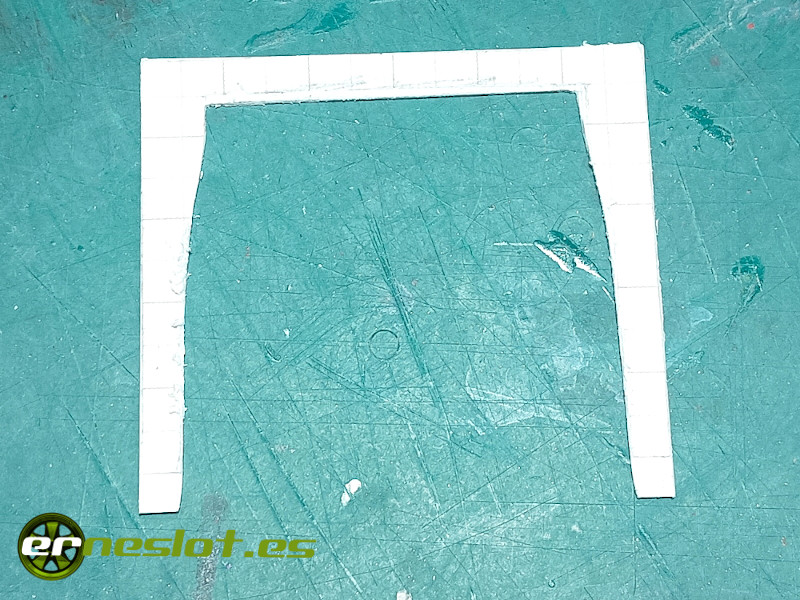

On a 80s modifications inspired car, side air intakes in the style of the Ferrari Testarossa were a must, as they were practically the essential aesthetic element in modifications from that era. I wanted to make them from scratch, cutting strips of plastic from credit cards...

...which I glued together...

...then cut them in half...

...and give them the right shape by sanding and filing...

...to finally glue them in place:

The side skirts are also another necessary element in a conversion. To help me define the skirt, I made the basic shape on two pieces of plastic...

...which I glued in place, first with cyanoacrylate and then reinforced with epoxy glue.

Finally, I attached the spoiler. The car was starting to take shape:

I corrected the shape of the spoiler piece, as I had intentionally made it large to adjust its dimensions later:

and little by little, I gave it the proper shape:

Since the rear looked a bit plain, I built additional grilles in the same way I had done with the side ones.


and I put them in place:
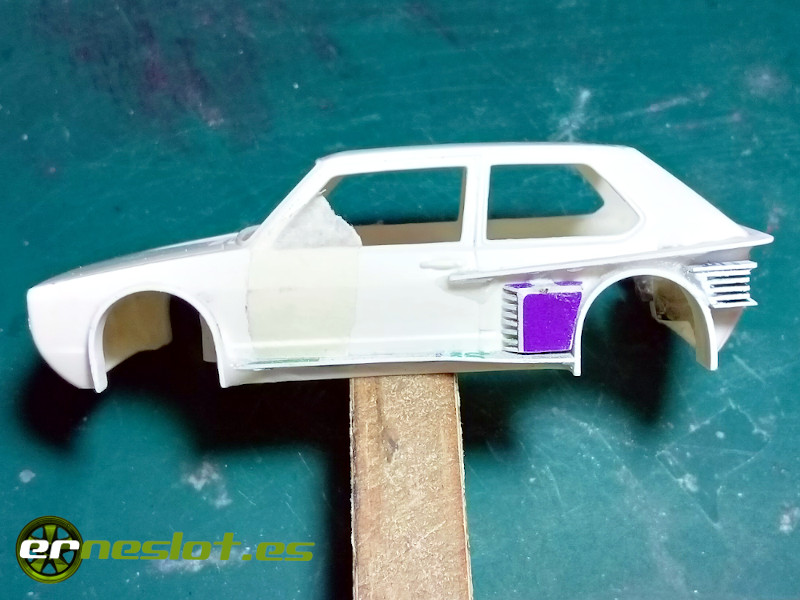

I also wanted to change the front of the car because I didn't like the round headlights, but I didn't want to make a radical change. Or rather, I did want to, but I didn't have enough time.

My initial idea was to make a grille across the entire width with the headlights behind it, but it was too much work for the little time I had, so I decided to use square headlights. To do this, I glued a couple of rods to the back as supports.

The purpose of these rods was to hold the grille in place so that it wouldn't change when I cut the headlights. Then I cut the round headlights out of the grille and glued some plastic strips to the body to define the new shape of the headlights.

The car's shape was now taking the form I wanted, and it was time to apply the two-part putty to the entire body, always using a little more than necessary so I could then refine it completely by gently sanding and filing.

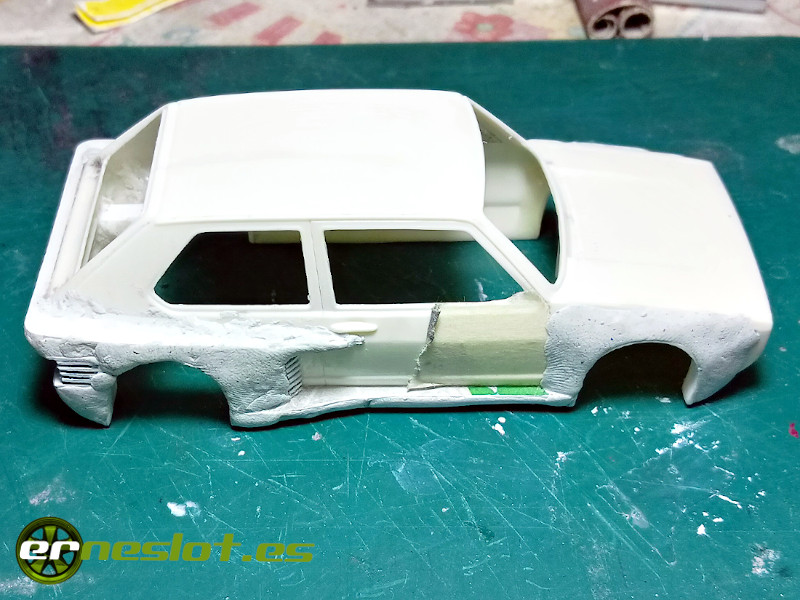
After sanding and filing the putty, the car looked like this:


As you can see, I modified the front of the car to fit the Golf Kamei front spoiler that came with the kit. I hadn't planned to add it, but the front of the car seemed too plain, and I wanted to give it a bit more detail.
With the main modeling work done, I applied a coat of Dupli-Color grey spray primer to prepare the bodywork for the painting stage.


As expected, some imperfections appeared, and I had to correct some parts that weren't to my liking. So, once again, the file and sandpaper were necessary, along with some Tamiya putty, to prepare the car's surface for painting.
Regarding the paint, I wasn't entirely sure what to choose, and I don't think I made the right decision. I wanted to paint it with acrylic paints that change color depending on how the light hits the surface, specifically the chameleon paints from Green Stuff World. I was torn between two shades, "Nebula Copper" and "Burning Gold." I liked both, but the second one had a golden tone that I preferred, and was the color chosen.
To achieve the iridescent paint effect, you first need to apply a coat of gloss black paint, over which you then apply the chameleon paint. I applied a coat of Humbrol gloss black enamel paint with an airbrush, and once it was completely dry, I lightly sanded it to remove any imperfections. Then I applied another coat of gloss black and let it dry for a few days (Humbrol enamels dry very slowly). With that second coat of black enamel completely dry, I applied three very thin coats of Green Stuff acrylic paint, which dried to this result:

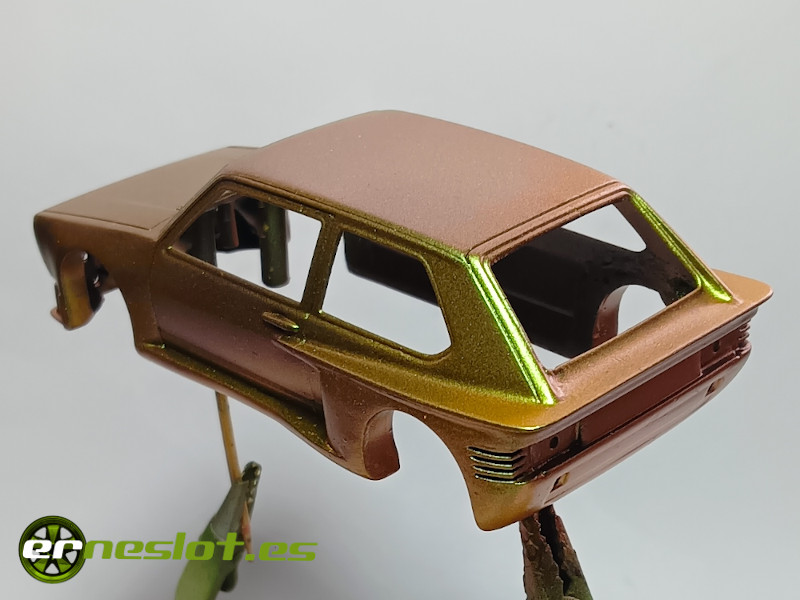

Once the paint was completely dry, I applied the six waterslide decals that make up the livery (which I made myself), and then applied two coats of automotive clear coat for protection. I always do the same thing: a first coat, which I lightly sand when it's completely dry to remove imperfections, and a second coat to perfectly seal the body. The second coat didn't turn out perfectly and left a slight orange-peel effect, but it's very subtle.
As I usually do, I masked off the rubber seals around the front and rear windows and painted them with Humbrol matte black enamel (reference 33), partly because I like the contrast of matte colors on a glossy surface and partly to break up the monotony of the paint scheme. And something I did for the first time was use the Tamiya panel liner to mark the body recesses on the doors and hood, a technique commonly used in static modeling but one I'd never used on a slot car before, and the result was very good, although it's not very clear in the photos.
Regarding the interior, I wanted to create something very 80s, so I reupholstered the seats included in the kit over a cream-colored carpet (Humbrol 34 matte white enamel), slightly modifying them to fit a shallower tray than the original. I also covered the dashboard in white leather (Vallejo Model Color gloss white 70.951). The driver figure is a pilot included in the kit with a resin head, to simulate a real driver (indeed, painting heads isn't my strong suit).
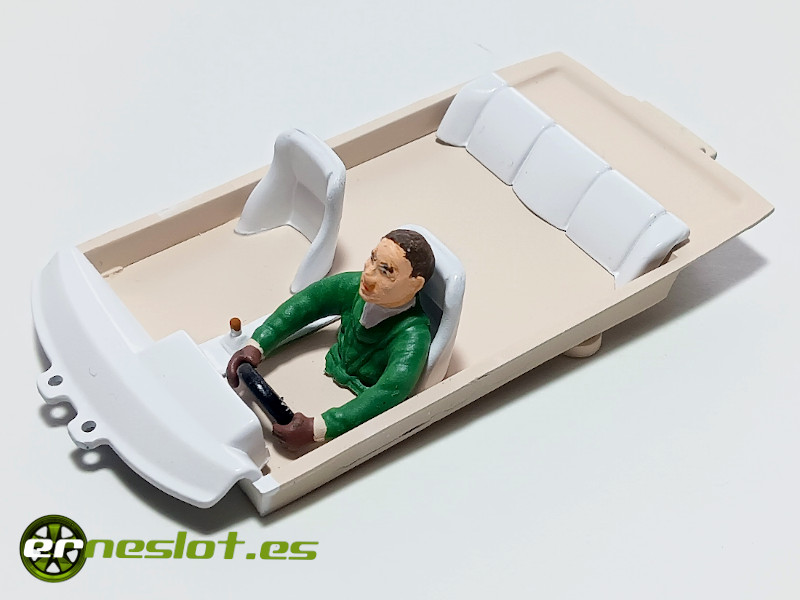

The color of the tray may look strange, but it's matte white. I don't know why, but all the Humbrol whites I've tried aren't pure white they tend more towards an off-white or cream tone, which is fine for some things but a nuisance for others. Regarding the color of the seats and dashboard, the gloss of the Vallejo white very effectively simulates the satin look of leather. Overall, I'm very happy with the result.
I also painted the interior of the car in the same shade of white to brighten the whole thing up, although it's not very noticeable once it's assembled.
Since it's such a unique slot car, the interior of the body would be visible when the rear screws were removed, so I painted the inside with Vallejo matte black (reference 70.950) and the posts that simulate the front shock absorbers with gloss red (Tamiya X-7 applied with a brush). The springs, both front and rear, are ballpoint pen springs cut to the appropriate length.

The kit included the corresponding headlights, but I didn't use them for two reasons: the front ones because I had changed their shape and, being round, they were no longer suitable, and the rear ones because I wanted something more 80s than the VW Golf's own headlights. And speaking of 80s taillights, nothing beats the Mercedes-Benz headlights with their characteristic slots, similar to those used by other brands like Ford (on the Granada and Escort models, for example) or Rover (on the SD1). To simulate them, I used the rim of a plastic CD case, which has a similar groove, very suitable for the rear lights but not so much for the front ones.
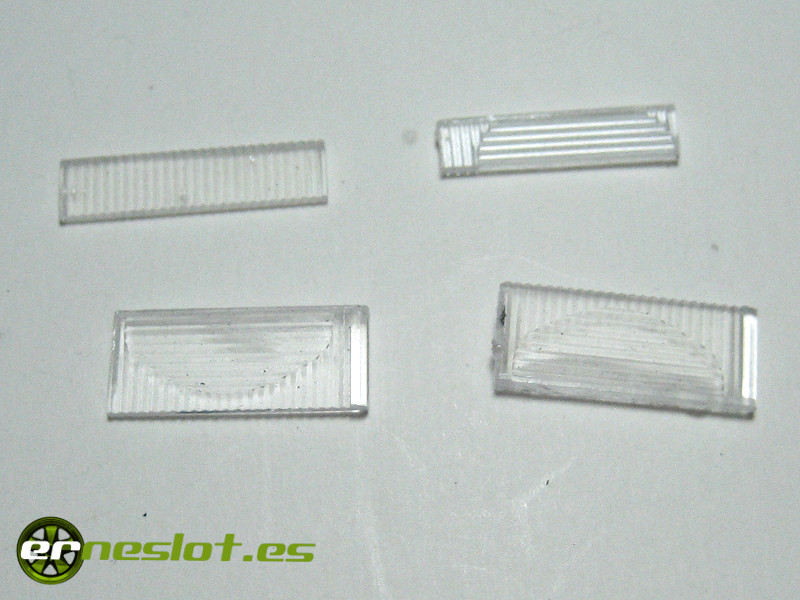
The headlights were very easy to make. I just had to cut a square piece from the rim of the CD case to the appropriate dimensions, which I painted on the grooved side with translucent orange to simulate the indicators and Tamiya silver-gray. For the taillights, the process was the same, but painted with Tamiya translucent orange and red, applied with an airbrush. This was a bit more laborious because I had to mask off the parts of the taillight and wait for one color to dry completely before applying the other:

To finish the body, all that remained was to make the rearview mirrors. I didn't want to use the one included in the kit because it is very delicate and wouldn't last long in place. I also didn't particularly like them, so I used some 3D resin mirrors that I glued to a triangular piece to attach them to the front corner of the windows. Since this is a race car, I made them removable so they could be taken off before putting the car on the track, they were then attached to the car by fitting into a hole I drilled in the window. The color and painting process were the same as for the body.

The wheels could only be one model: the BBS honeycomb wheels, which were widely used at the time. In this case, they are the original ones from the kit, painted in Tamiya metallic aluminum (reference X-11), to which I added an SRC photo-etched insert, and from my point of view, they look spectacular. However, the wheel alignment leaves much to be desired, we'll see how this affects the car when I put it on the track.

As you can see, I haven't talked much about the mechanics, which shows the little interest I've put into that aspect of the car. It's a long-can motor with around 18,000 RPM, the same for all participants in the championship (which I think is fantastic), with a 9-tooth pinion and a 26-tooth crown gear, initially. I say initially because when I do track tests, I might use a slightly smaller one depending on how the car performance. The narrow front tires are SCX (reference 044) slightly lowered, which fit perfectly on the front rims of the kit, and the rear tires are Mitoos M001 for 15 mm rims, looking for a bit more competitiveness.

At this point, all that remained was to register the car for use on public roads, and the car was finished.


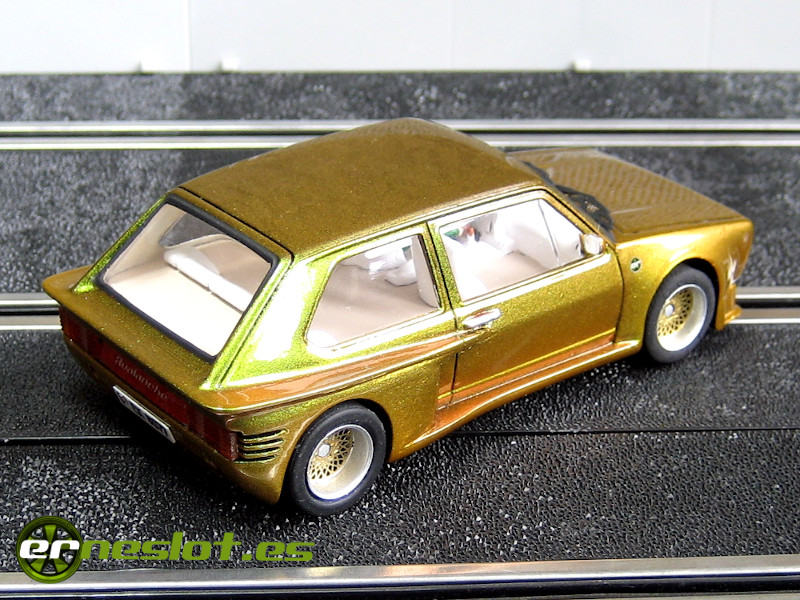


The Erneslot Specials Avalanche is now finished. I'm more than satisfied with the result, although there were a few things I would have liked to improve, but time is what it is, and I had a deadline, so some details weren't as polished as I would have liked, especially some paintwork. Anyway, this is basically where I wanted to get to and the car I wanted to make; on the one hand, as a tribute to the tuners of the 80s that I liked so much as a child, especially Koenig-Specials and Gemballa, and on the other hand, to be ready in time to participate in the full Subdesarroller championship, which is quite an achievement considering the little time I have to build this little cars.
| Chasis | Original, modified |
| Wheelbase | 63 mm. |
| Dimensions (L x W x H) | 118 x 57 x 40 mm. |
| Weight | 96 grs. |
| Motor | Mabuchi long can |
| Front tires | Scalextric 044 |
| Rear tires | Mitoos M001 |
Fortnightly updates, new cars and more in www.erneslot.es

